

The World Is on Fire. Here’s What Nigerian Developers Must Do Right Now to Survive It.
Global conflicts are inflating construction costs, choking supply chains, and reshaping capital flows. The developers who act now will build empires. Those who wait will build nothing at all.
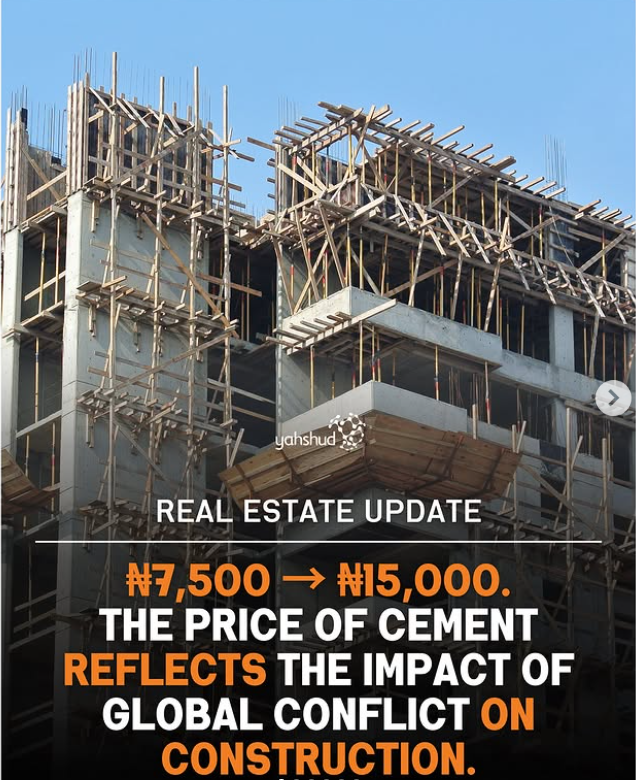
Let’s start with a number that should keep every Nigerian developer awake at night: ₦15,000.
That’s the current price of a 50kg bag of cement in several parts of Nigeria as of March 2026. Just three months ago, it was ₦7,500. Steel is up 20%. Sharp sand is up 25%. Tiles and sanitary fittings — most of which are imported — have effectively doubled.
If you’re a developer in Lagos, Abuja, or Port Harcourt, you already know this story in your bones. What you may not fully appreciate is that these price spikes are not just the product of local inflation or naira depreciation. They are the direct downstream effects of geopolitical earthquakes happening thousands of kilometres from your construction site.
A military conflict between the US, Israel, and Iran has disrupted the Strait of Hormuz, through which roughly 20% of the world’s crude oil and LNG flows. The US–China trade war has pushed tariffs past 145% on some goods, sending shockwaves through global supply chains. Brent crude has lurched wildly — surging on Middle East instability, then collapsing on recession fears from weakening Chinese demand.
For Nigerian real estate developers, these are not news headlines to scroll past. They are operating conditions. And the developers who treat them as such — who adapt their procurement, financing, design, and business models right now — will be the ones still standing when the dust settles.
Here is what is actually happening, and precisely what you should do about it.
1. The Oil Paradox: Why Higher Oil Prices Are Killing Your Margins
Nigeria is an oil-exporting nation. When geopolitical instability drives crude prices up, the national treasury benefits. But here is the counter-intuitive truth that developers need to internalise: higher oil prices are devastating for the construction industry.
Construction is one of the most energy-intensive sectors in any economy. The production of cement alone requires enormous energy inputs. Steel manufacturing, glass production, aluminium processing — all of them are energy hogs. And it doesn’t stop at the factory gate. Every bag of cement, every truckload of granite and sand that moves across Nigeria does so on diesel-powered logistics. When oil prices surge, every node in the construction supply chain gets more expensive simultaneously.
“Construction is inherently energy-dependent. The production of cement, steel, glass and aluminium requires substantial energy input, while the transportation of building materials relies heavily on diesel-powered logistics. As global oil prices rise, the cost of these inputs inevitably increases.”
By late February 2026, cement in Abuja hit ₦10,500 per bag — a 7.1% jump in a single month. And that was before the most recent Strait of Hormuz disruption. Industry analysts estimate that even a moderate, two-month conflict would add 0.3 to 0.4 percentage points to global inflation. For Nigeria, where materials inflation is already structurally elevated, the concern is that temporary global price spikes will trigger a permanent upward reset in the cost of locally manufactured goods like cement.
The real danger: Nigeria’s cement market operates as what analysts call a “spatially fragmented oligopoly.” Price leadership by dominant producers — Dangote, BUA, and Lafarge — often neutralises the competitive benefits of surplus production capacity. When global energy costs spike, these producers pass costs through rapidly. When costs ease, prices rarely come back down at the same speed.
WHAT TO DO NOW Lock in material prices immediately. Forward contracts with cement and steel suppliers, even at a slight premium over today’s spot price, will look like bargains within months. If you’re starting a project in Q2 or Q3 2026, procure core materials now. The “Inflation Tax” — the money you lose simply by letting time pass between budgeting and buying — is the silent killer of developer margins in this environment.
2. Supply Chain Rerouting Is Adding Weeks and Millions to Your Projects
The Strait of Hormuz and the Red Sea are not just oil chokepoints. They are critical arteries for global cargo shipping. When conflict forces vessels to reroute around the Cape of Good Hope, it adds two to three weeks to delivery timelines and dramatically increases shipping insurance premiums.
For Nigerian developers, this is not an abstraction. Finishing materials, specialised fittings, electrical components, plumbing fixtures — a significant share of these inputs are imported. Longer shipping times mean delayed deliveries. Higher freight costs get passed straight through to the developer. And the unpredictability of it all turns project budgeting from a science into a dice throw.
Industry reports from early 2026 are stark: 65% of companies globally already face at least one supply chain bottleneck. The simultaneous disruption of both the Red Sea corridor and the Strait of Hormuz has created what industry analysts now describe as the “new normal” of geopolitical procurement risk.
“The ‘certainty’ in 2026 will come from agility. Organisations that act early to lock in material prices, adjust procurement strategies to account for the Cape of Good Hope route, and adopt alternative technologies will be the most resilient.”
WHAT TO DO NOW Diversify your supplier base immediately. Identify at least two alternative sources for every critical imported input. Build buffer stock into your procurement plans — the old just-in-time model is broken in a world of contested shipping lanes. And start building relationships with local fabricators and material producers who can substitute for imported equivalents. The cost may be marginally higher today, but the reliability premium is worth far more than the price differential.
3. The US–China Trade War Is Reshaping What Your Buyers Can Afford
The US–China tariff war is not just about Washington and Beijing. It is reshaping the global economic conditions that determine how much money Nigerians — and Nigeria’s diaspora investors — have available to spend on property.
When sweeping tariffs were announced in April 2025, Brent crude fell below $65 per barrel, perilously close to Nigeria’s budget breakeven price of $60. With oil revenue comprising about 60% of the country’s income, a sustained downturn translates directly into reduced government spending, stalled infrastructure projects, and lower economic confidence.
At the same time, the trade war is driving inflation upward across import-dependent economies. Higher prices for food, fuel, and consumer goods squeeze household purchasing power. When families are spending more on basic necessities, they have less capacity to save for housing deposits, service mortgage payments, or pay higher rents. For developers, this means demand compression at exactly the point where costs are rising.
The compound effect: Rising construction costs plus declining buyer purchasing power equals a shrinking pool of viable projects. Developers who keep building luxury units for a narrowing elite market may find themselves sitting on unsold inventory. The real opportunity is in right-sizing — building the compact, efficient, mid-market units that match what people can actually afford.
WHAT TO DO NOW Reassess your product mix. The Nigerian market is signalling loudly that demand is shifting toward smaller, more affordable units with flexible layouts and energy efficiency features. Housing units in 2026 are expected to become more compact, with larger living spaces becoming a luxury for a smaller segment of the population. Developers who pivot toward 1–2 bedroom apartments with smart finishes and low running costs will find a much deeper buyer pool than those chasing the high-end segment.
4. Foreign Capital Is Going Risk-Off. Here’s How to Stay in the Game.
When the world gets turbulent, institutional investors have a predictable reflex: they pull money from emerging markets and park it in safer assets. This matters enormously for Nigerian real estate, which saw FDI reach $1.8 billion in 2025 — a five-year high. That momentum is now at risk.
Elevated global uncertainty tightens international capital flows and pushes borrowing costs higher. Higher interest rates raise the cost of development finance, increase mortgage costs, and dampen effective housing demand. Institutional investors adopt what the market calls a “risk-off” stance, delaying or cancelling commitments to markets perceived as volatile.
“Institutional investors typically adopt a risk-off approach during geopolitical instability. Reduced capital inflows into emerging markets could affect large-scale housing and urban development projects that depend on structured financing and foreign participation.”
But here’s the flip side: while institutional foreign capital retreats, diaspora capital is surging. Remittances hit $23 billion in 2025, now exceeding 11% of GDP. Nigerian professionals abroad are increasingly channelling funds into real estate as both a hedge against global inflation and a strategic response to anti-immigrant sentiment in their host countries. This is “smart money” — it’s dollar-denominated, inflation-resistant, and motivated by long-term wealth building rather than short-term speculation.
WHAT TO DO NOW If your capital strategy depends on institutional foreign investors, broaden your base. Build structured products that make it easy for diaspora investors to participate — fractional ownership, dollar-denominated investment notes, and transparent reporting through proptech platforms. The diaspora investor wants three things: title security, professional management, and digital access. Give them that, and you tap into the single most resilient capital source in the Nigerian market.
5. The Government’s Budget Lockdown Is a Signal. Read It.
In March 2026, the Federal Government introduced a “budget lockdown” on new capital projects, capping sectoral capital budgets at just 70% of 2025 allocations. This was a direct response to the fiscal pressure created by converging global crises — oil price volatility, trade disruption, and the costs of maintaining economic stability.
For developers who depend on government-led infrastructure as a catalyst for property development, this is a yellow flag. The Lagos–Calabar highway, Lekki Deep Seaport expansion, and rail freight projects have been powerful drivers of property value growth in surrounding corridors. If infrastructure delivery slows, the pipeline of emerging hotspots that have attracted speculative and genuine investment could lose momentum.
The strategic read: Don’t bet your portfolio entirely on government infrastructure timelines. Focus on corridors where infrastructure is already delivered or substantially committed. Emerging hotspots linked to incomplete or unfunded infrastructure carry amplified risk in a fiscal contraction environment.
WHAT TO DO NOW Audit your land bank against infrastructure delivery status, not just infrastructure announcements. Projects along completed road networks, operational rail lines, and functioning port zones carry materially lower risk. Be cautious about acquiring land in corridors where the enabling infrastructure is still at planning stage — budget lockdowns have a way of turning two-year timelines into five-year waits.
6. Alternative Materials Aren’t a Nice-to-Have Anymore. They’re a Survival Strategy.
When the price of a bag of cement doubles in six months and imported finishing materials are at the mercy of contested shipping lanes, the question of alternative building materials stops being an idealistic conversation and becomes a hard commercial imperative.
The good news is that Nigeria has viable options. Compressed Earth Blocks — made from local soil stabilised with a small percentage of cement — offer thermal insulation, lower cost, and reduced carbon emissions. Interlocking bricks eliminate the need for mortar, cutting both cement consumption and construction time. Bamboo, which grows abundantly in Nigeria’s climate, is being developed into Cement Bamboo Frame Technology for structural applications. Recycled steel is available at lower cost with retained durability. And prefabricated panels, manufactured in controlled environments and assembled on-site, dramatically reduce labour costs and construction timelines.
“If building materials are expensive, housing will be expensive. We must address the fundamentals.”
Interlocking block systems have already demonstrated a 34% cost reduction compared to conventional concrete blocks in documented Nigerian projects, with 60% faster construction timelines. The technology is proven. What’s been lacking is adoption at scale.
WHAT TO DO NOW Pilot at least one alternative material system on your next project. Start with interlocking blocks or Compressed Earth Blocks for perimeter walls. Test bamboo composite boards for internal cladding. The data on cost savings is compelling, and early movers will build the expertise and supplier relationships that become competitive advantages as conventional material costs continue to climb. The era of cement-or-nothing is over.
7. Value Engineering Is the New Competitive Moat
In a stable cost environment, Nigerian developers could afford to over-specify materials, absorb minor inefficiencies, and still deliver profitable projects. That environment no longer exists. Every naira of waste is now a naira of margin destroyed.
Leading firms are responding with what the industry calls “value engineering” — the systematic analysis of every design and specification decision to maximise function while
minimising cost. This means optimising slab thickness, rationalising rebar layouts, reusing formwork, planning waste management to convert demolition debris into fill material, and designing buildings with maintainability and energy efficiency built in from the start.
The adoption of Building Information Modelling and AI-assisted project management tools is no longer a luxury for large corporate developers. These technologies reduce project delivery times, catch specification errors before they become expensive site problems, and provide the cost visibility that makes fixed-price contracting possible.
The bottom line: In a market where material costs can shift 20–40% within a single quarter, the developer who can consistently deliver projects at lower cost-per-square-metre — without sacrificing structural quality — has an almost unassailable competitive advantage. That advantage comes from systems and technology, not from luck.
WHAT TO DO NOW If you don’t have a formal value engineering process, build one. Start by benchmarking your cost-per-square-metre against industry averages, then identify the three to five line items where over-specification is most expensive. Invest in BIM software and train your project managers to use it. The upfront cost will pay for itself within a single project cycle.
8. Think in Naira, Earn in Dollars, Build with Local
This final point ties the entire strategy together. The developers who will thrive in the current global environment are those who master the art of arbitrage across three dimensions: earning revenue in hard currency, controlling costs through local sourcing, and serving a demand base that is structurally insulated from short-term economic shocks.
Dollar-denominated rental income from short-let properties and diaspora-targeted investments provides a natural hedge against naira depreciation. Leases in prime Lagos locations already command around $5,000 per month for four-bedroom homes, with gross yields of 4–6%. Diaspora remittances provide quasi-dollar funding for developers who structure their offerings to attract this capital.
At the same time, reducing dependence on imported materials — through local sourcing, alternative technologies, and domestic manufacturing partnerships — insulates the cost base from the global supply chain disruptions that are now a permanent feature of the landscape. And Nigeria’s demographic momentum — a population approaching 260 million, with a housing deficit of over 22 million units and urbanisation accelerating — provides a demand floor that no geopolitical shock has yet been able to penetrate.
WHAT TO DO NOW Structure your next project to capture all three dimensions: diaspora-targeted sales or short-let income for dollar-denominated revenue; locally sourced materials and value-engineered design for cost control; and location within high-demand corridors driven by infrastructure and population growth. This triangulation is the most robust business model available to Nigerian developers in 2026.
The Window Is Closing. The Opportunity Is Open.
The convergence of global crises — the Middle East conflict, the US–China trade war, supply chain disruption, and fiscal tightening — is creating the most challenging operating environment Nigerian developers have faced in a generation. But it is also creating the conditions for structural transformation.
Real estate has overtaken oil as one of the primary drivers of the Nigerian economy, now contributing a combined 15.9% to GDP alongside the construction sector. FDI hit a five-year high. Diaspora investment is at record levels. And the demographic fundamentals — urbanisation, population growth, a 22-million-unit housing deficit — are not going anywhere.
The developers who treat this moment as an invitation to innovate — who embrace alternative materials, value engineering, diaspora capital structures, and technology-enabled project management — will not just survive the global turbulence. They will build the companies that define the next era of Nigerian real estate.
Those who wait for the storm to pass will find that by the time it does, the landscape will have been reshaped by those who learned to build in the wind.
The question every Nigerian developer needs to answer this quarter: Are you building a business that depends on the world being stable — or one that thrives precisely because it isn’t?


