

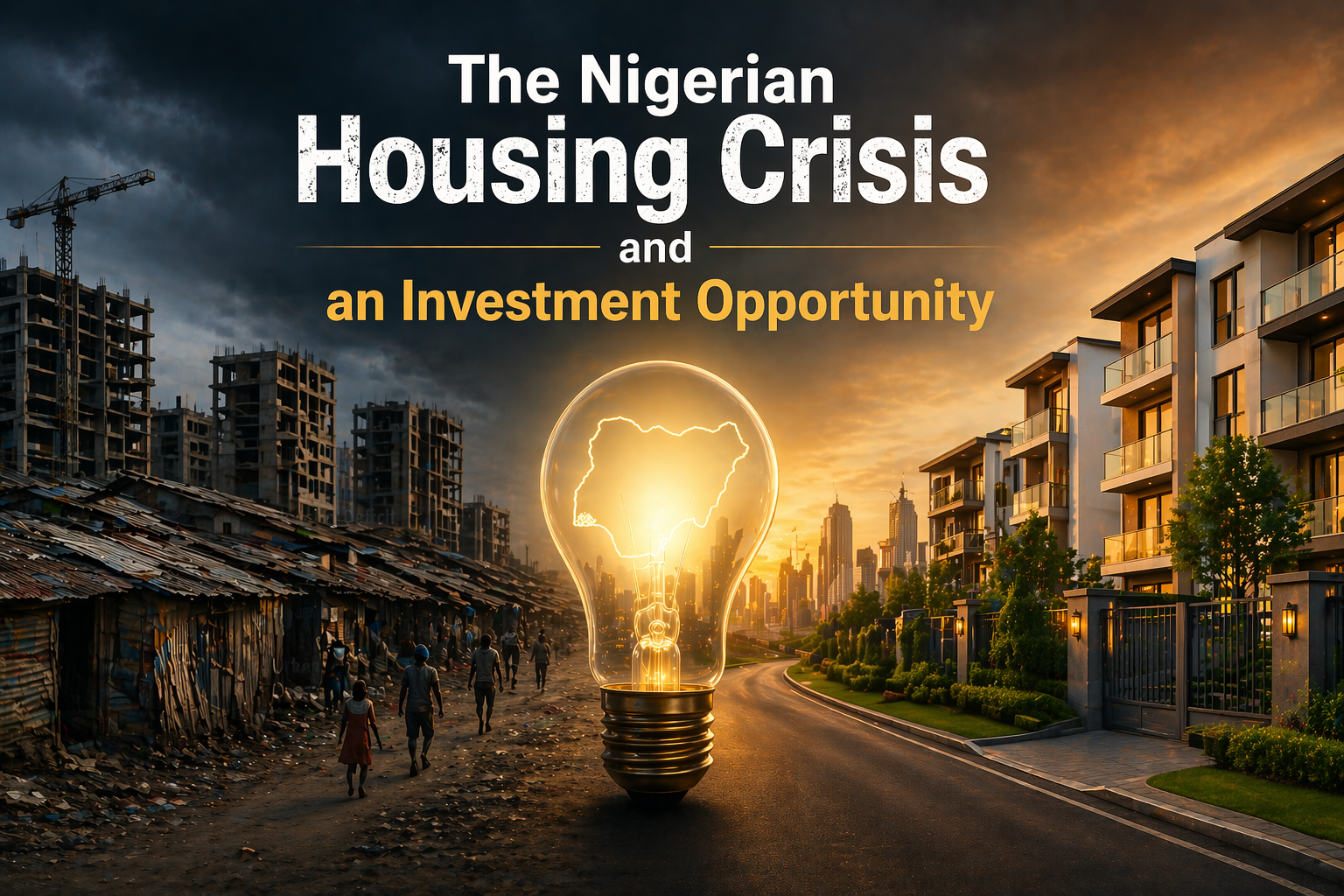
Guide 3: The Nigerian Housing Crisis and an Investment Opportunity
Nigeria has a housing problem. Most people who live here already know that, either from personal experience or from watching rent climb year after year in Lagos, Abuja, and every major city in between. What fewer people think about is what that problem means for investors.
A housing deficit is, at its core, a demand problem. There is far more need than supply. And in any market where demand consistently outpaces supply, the underlying assets tend to hold and grow their value. Understanding the Nigerian housing crisis is not just a social exercise. It is one of the clearest investment signals available in this market.
This guide looks at the scale of the problem, what is driving it, where the investment opportunity lives within it, and how Yahshud positions investors to benefit responsibly.
The Scale of the Problem
The Housing Deficit
A Federal Ministry of Housing and Urban Development technical committee put Nigeria’s 2025/26 housing deficit at 14.92 million units, with an additional 15.2 million homes classified as structurally inadequate or outright substandard. Earlier estimates cited figures as high as 28 million units. Either figure describes a crisis of extraordinary scale.
Supply Cannot Keep Up
Nigeria needs an estimated 700,000 new housing units annually to keep pace with population growth and urbanisation. Fewer than 100,000 units are currently delivered each year. That gap is not closing. It is widening.
Urban Affordability Has Collapsed
In Lagos, a modest one-bedroom apartment now rents for over N1,000,000 annually. That is nearly double the national minimum wage of N70,000 per month. For most Nigerians, homeownership is no longer a realistic near-term goal. Over 70% of the urban population lives in inadequate housing conditions.
The Monetary Scale
The Federal Ministry of Housing estimates the cost of closing the deficit at between N21 trillion and N59 trillion. No government programme alone will close that gap. Private capital is not just welcome here. It is necessary.
The housing deficit is not just a social failure. It is a structural imbalance between supply and demand that has been building for decades and shows no sign of resolving quickly. For investors, that is a signal worth understanding.
What Is Driving the Crisis
Rapid Urbanisation
Nigeria’s urban population is expected to grow by over 200 million people by 2050, according to the World Bank. Lagos alone is already home to over 20 million people. As more Nigerians migrate to cities in search of opportunity, demand for housing intensifies in markets that are already severely undersupplied.
Surging Construction Costs
Cement now costs approximately N12,000 per bag, having nearly tripled since 2023. A 16mm iron rod that cost N2,000 in 2023 now costs over N18,000. These increases are directly tied to naira devaluation, which makes imported building materials significantly more expensive. Developers are passing those costs on, and buyers and renters are bearing them.
The Land Use Act and Title Complexity
Nigeria’s Land Use Act vests all land in state governors. Obtaining a Certificate of Occupancy, securing Governor’s Consent, and navigating the land titling process is time-consuming, expensive, and in many states, opaque. These barriers slow development and raise the cost of every legitimate property transaction.
Near-Absent Mortgage Market
Nigeria’s mortgage penetration rate is below 5%, one of the lowest in the world. Without accessible long-term housing finance, most Nigerians cannot purchase property regardless of desire. This keeps demand for rental housing consistently high and suppresses the supply of owner-occupied homes.
Where the Investment Opportunity Lives
Supply Scarcity Supports Prices
When demand consistently exceeds supply, prices in well-located markets tend to hold and grow. Prime Lagos locations like Ikoyi, Victoria Island, and Banana Island have demonstrated this repeatedly. Constrained supply of quality assets in high-demand areas is a protective factor for investors in those locations.
Rental Income Is Resilient
Because homeownership is inaccessible for the majority of urban Nigerians, rental demand remains structurally high. Properties in prime locations are increasingly leased on dollar-denominated terms, providing investors with returns that track the dollar rather than the naira. This is a meaningful protection in an environment of ongoing currency pressure.
Capital Appreciation Has Been Consistent
Despite economic volatility, property values in prime Lagos markets have shown consistent appreciation. Home values in Lagos increased by approximately 13% in recent years, even during difficult economic conditions. Real estate has outperformed many conventional asset classes as a store of value.
The Market Is Projected to Grow
Nigeria’s real estate sector is projected to grow at a compound annual growth rate of 7.52% to reach USD 3.02 trillion between 2024 and 2028. The sector outperformed crude oil in GDP contribution in early 2024. Long-term investors who enter structured, well-located positions now are positioned to benefit from that growth.
The housing crisis means millions of Nigerians cannot afford adequate shelter. It also means that well-managed, well-located real estate assets are in persistent, structural demand. Both realities coexist and investors need to understand both.
How Yahshud Positions Investors Inside This Opportunity
Focus on Prime, High-Demand Assets
Yahshud operates from Ikoyi, Lagos and focuses on assets in prime, high-demand locations where the supply-demand imbalance is most pronounced and most durable. We are not chasing peripheral markets with inflated projections. We invest in locations with a proven track record.
Structured Access Through RAIN
RAIN (Real Asset Investment Notes) allows investors to access professionally managed real estate opportunities without buying a whole property. Every investment is asset-backed, Shariah-compliant, and comes with full documentation and investor reporting. You can explore current opportunities at raininvestor.com.
Professional Asset Management
We handle tenant management, maintenance, renewals, and reporting. You own the investment exposure. We manage the execution. This is how real estate investment should work for someone who wants to build wealth without becoming a landlord.
Ethical Finance That Protects the Investor
Every Yahshud investment is structured to separate investor funds from our operational activity. Legal frameworks are in place before your money moves. Due diligence is completed on every asset before it is offered. We show you the realistic scenario, not just the best case.
What Responsible Investors Watch For
- Verified title documentation before committing capital
- A registered investment manager with a physical presence and CAC number
- Clear documentation of investment structure, returns, and exit terms
- Separation of investor funds from the operator’s working capital
- Regular, accessible reporting on asset performance
If you cannot get clear answers to all of these questions, that is your answer.
Conclusion
Nigeria’s housing crisis is real. It affects millions of families and it is getting harder to ignore. But within that crisis is a structural investment signal that serious investors should not overlook.
The gap between supply and demand in Nigeria’s housing market is not closing anytime soon. The forces driving it are structural and long-term. That means assets serving the demand side of that market have enduring value.
Yahshud exists to help investors access that value responsibly. Through structured, ethical, professionally managed investment products, we make it possible to participate in Nigeria’s real estate opportunity without the complexity, opacity, or risk of going it alone.
To learn more or explore current opportunities, visit yahshud.com or raininvestor.com, or contact us directly at info@yahshud.com.
Yahshud | Ethical Real Estate Investment Management | yahshud.com | info@yahshud.com | +234 809 675 8004
Tags:
Share:


