

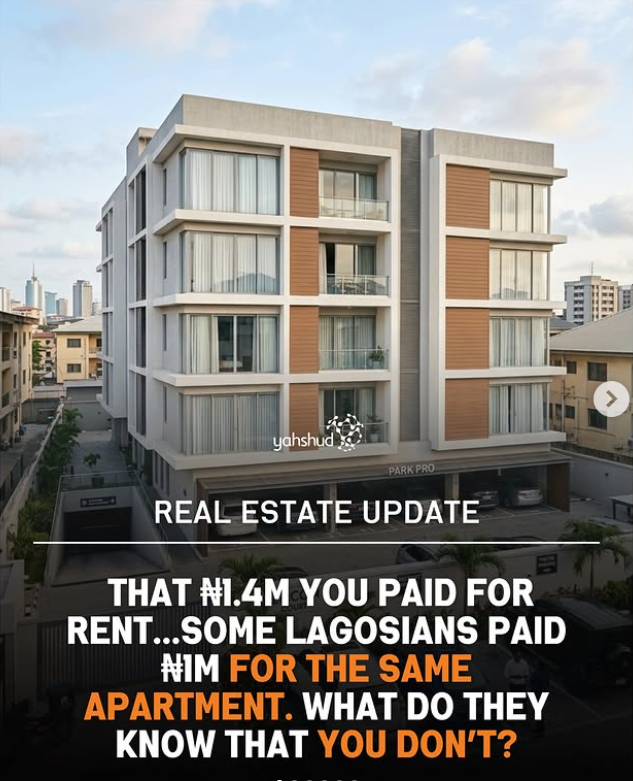
Rent in Lagos Has Jumped 50–200% in Two Years. Here Are 9 Strategies Real Lagosians Are Using to Beat the Market.
Lagos now ranks among Africa’s four most expensive rental cities. The average tenant spends 70% of their income on rent — more than double the global benchmark. But inside the chaos, there are deals. You just have to know where to look.
Let’s start with the number that explains everything: 70%.
That is the current income-to-rent ratio for the average Lagos tenant, according to leading real estate analysts. The United Nations recommends a maximum of 30%. Lagos is at more than double that threshold. And if you’ve tried to find an apartment in this city recently, you already know this is not a statistic — it is your lived reality.
A new report by Fortren & Company ranks Lagos as the fourth most expensive city to rent in across all of Africa, behind only Abidjan, Cape Town, and Accra. A luxury two-bedroom apartment in prime Island locations like Ikoyi, Banana Island, and Victoria Island now averages ₦26.8 million per year. Some ultra-luxury developments in Ikoyi command rents as high as $130,000 annually.
But this is not just an “Island problem.” The squeeze is citywide. A one-room apartment in Ojo that cost ₦300,000 a year ago now goes for ₦650,000. A three-bedroom in the Ojo area jumped from ₦900,000 to ₦1.6 million in a single year. In Abuja, a self-contained apartment that used to rent for ₦400,000 now sits at ₦800,000 to ₦1.5 million.
“In the last 24 months, rents have increased by 50–200 percent, pushing the income-to-rent ratio to 70 percent — more than double the 30 percent benchmark approved by the United Nations.”— Chudi Ubosi, Principal Partner, Ubosi Eleh + Co
The forces behind this are structural, not temporary: chronic undersupply (Lagos has a housing deficit of roughly 3.4 million units), naira depreciation that has doubled the cost
of imported building materials, construction cost inflation, a broken mortgage system with rates above 25%, and a rental culture where landlords routinely demand one to two years’ rent upfront.
None of this is going to reverse itself overnight. But within this punishing market, there are strategies that informed tenants are using to find genuinely better deals. Here are nine of them.
1. Stop Searching on the Island. The Best Value in Lagos Is on the Mainland — and the Gap Is Enormous.
This is the single most impactful shift a renter can make. The price differential between Lagos Island and the Mainland is not a gentle gradient — it is a cliff. Service charges alone in Island locations (Ikoyi, Victoria Island) run ₦1.5–4.5 million per year. On the Mainland (Gbagada, Ikeja, Surulere), the same charges are ₦300,000–₦1 million.
More importantly, rental yields on the Mainland are actually higher than on the Island, meaning landlords are getting better returns in areas like Yaba, Maryland, and Gbagada (7–9% yields versus 3–4% in prime Island zones). Higher landlord returns mean more competitive supply and more negotiating room for tenants.
The Red Line rail corridor is quietly transforming Mainland connectivity. Neighbourhoods like Yaba, Ikeja, and Oshodi are seeing renewed interest from professionals who want shorter commutes without Island prices. These areas deliver modern, well-serviced apartments at a fraction of the cost.
Practical move: A well-finished 2-bedroom apartment in Gbagada or Maryland will cost roughly one-third of an equivalent unit in Lekki Phase 1, with comparable security and amenities. Run the numbers before defaulting to the Island.
2. The “Total Package” Is the Real Price. Learn It Before You Sign Anything.
Lagos has a unique rental cost structure that traps uninformed tenants. The advertised rent is never the final price. The “Total Package” — the actual amount you need to hand over before you get keys — includes the base rent plus 25–40% in additional charges: agency fees, legal fees, caution deposits, and the increasingly expensive service charge.
While the Lagos State Tenancy Law stipulates that agency and legal fees should not exceed 10% each, market reality in 2026 often sees these fees combined with a “Caution Fee” that significantly inflates the upfront cost. Agents routinely charge ₦150,000–₦500,000 in opaque “agent and agreement” fees on top of the rent.
Always calculate the Total Package before committing. A ₦1 million annual rent can easily become ₦1.35–1.4 million once fees are added. If an agent’s fees exceed 10% of annual rent, cite the Lagos State Tenancy Law and negotiate down or walk away.
Tenants who are aware of the law and negotiate firmly can save ₦100,000–₦300,000 on a single transaction. Most agents will back down from inflated fees when they sense you know your rights.
3. Negotiate Directly with Landlords. Agents Are Inflating Your Rent.
This one is uncomfortable but essential. Lagos residents are increasingly pointing to real estate agents as a direct cause of rent inflation. Lagosians have formally petitioned the state House of Assembly to regulate agent activities, citing cases where agents collude with landlords to double rents at renewal.
“I was seeking a 2-bedroom flat at Oke-Afa. When I saw one at ₦1 million, the agent asked me to pay ₦500,000 for ‘agent and agreement,’ which I still do not know what it means till today. I had no option but to pay.”— A Lagos tenant, via Economy Post
The structural issue is clear: most Lagos agents are unlicensed, and their incentive is to maximise the transaction value (since their fee is a percentage of rent). When an agent convinces a landlord to raise rent from ₦900,000 to ₦1.6 million, the agent’s own fee nearly doubles.
Practical move: Where possible, deal directly with landlords. Use community networks, church or mosque notice boards, word-of-mouth, and verified online listings to find properties without agent intermediaries. When you must use an agent, insist on a transparent fee breakdown before viewing any property.
4. Power Is the Hidden Rent Multiplier. Prioritise It in Your Search.
Here is a detail that most rental guides ignore but every Lagosian lives: power reliability is the single biggest hidden cost differentiator in the Lagos rental market. Apartments with proper inverter and generator setups command premiums of 20–40% over comparable units without them.
In many Lekki estates, a ₦1 million service charge covers everything except the electricity you actually consume. Diesel deposits, generator maintenance levies, and “hours-based” power billing systems add substantial hidden costs. A seemingly cheap apartment in an estate with an unreliable power setup will cost you far more in diesel, fuel, and inverter batteries than the rent you saved.
Practical move: When viewing apartments, ask three questions: (1) What is the estate’s power arrangement — grid, generator, solar, or hybrid? (2) Is the service charge “all-inclusive” or does it exclude electricity? (3) What has been the actual monthly power cost for the current tenant? This due diligence alone can save you ₦500,000+ per year.
5. Time Your Search. Lagos Rents Have a Season.
Lagos’s rental market is not uniformly hot throughout the year. Demand peaks from October through January, driven by the December diaspora influx, corporate relocations, and the general year-end reshuffling. Landlords and agents know this and price accordingly.
Conversely, the period from February through May tends to be softer. Fewer people are actively searching. Landlords with vacant units that sat empty through the holiday rush become more flexible. And the psychological pressure of “you’d better take it now before someone else does” eases.
Well-priced Lagos rentals typically find tenants within 30–90 days. But overpriced units can sit empty for six months or longer. If you encounter a unit that has been vacant for more than 60 days, the landlord is almost certainly open to negotiation — even if they do not say so.
Practical move: Begin your apartment search in February or March. You will face less competition, encounter more motivated landlords, and have significantly more negotiating leverage than during the Q4 frenzy.
6. Look Where the Infrastructure Is Going, Not Where It Already Is
Lagos property values — and by extension, rents — are increasingly infrastructure-led. The neighbourhoods experiencing the steepest rent increases are those along new transport and commercial corridors. Properties within 5km of the first section of the Lagos–Calabar Coastal Highway (opened in 2025) are already seeing 25–40% price increases.
The flip side of this dynamic is the opportunity for tenants who are willing to move slightly ahead of the infrastructure curve. Areas that are one stage behind the current hotspots — further along the Lekki–Epe corridor, or in peri-urban zones where road upgrades are planned but not yet complete — offer significantly lower rents with the expectation of improving connectivity within 12–24 months.
The emerging pattern is a concentric expansion outward from established hubs. Ajah and Sangotedo are today what Lekki Phase 1 was five years ago. Ikorodu is being repositioned by rail connectivity. The smart renter positions themselves one neighbourhood ahead of the wave.
Practical move: Research the Lagos Metropolitan Area Transport Authority’s infrastructure pipeline. Neighbourhoods adjacent to planned rail stations, road upgrades, and port zones offer 30–50% rent discounts today with improving commute times tomorrow.
7. The Advance-Rent Trap: Negotiate It Down or Structure It Differently
The practice of demanding one to two years’ rent in advance is perhaps the single most punishing feature of the Lagos rental market. It is a direct consequence of supply scarcity, distrust in tenant creditworthiness, and the absence of a functional rental insurance or credit-scoring system.
But it is not immovable. Landlords who have had units sitting empty for months will often agree to shorter advance periods — six months, or even quarterly payments — when presented with a credible tenant and a firm offer. Corporate tenants who can provide employer guarantees or direct salary deductions sometimes negotiate monthly payment structures.
“Africa’s rental market is one of the most rigid in the world. 50 percent of traditional rental transactions require at least 3 months of rent in advance. In Nigeria, demand far outstrips supply, giving landlords leverage to charge one to two years’ rent in advance.”— Martin Uche, Fortren & Company
Practical move: Never assume the advance period is non-negotiable. Offer a longer lease term (2–3 years) in exchange for a shorter advance period. Many landlords value tenancy stability over upfront cash, especially if they have experienced the cost and hassle of tenant turnover.
8. Consider the Short-Let Market — But Do the Maths Carefully
Lagos’s short-let apartment market has grown explosively. Serviced apartments in high-demand areas offer flexibility, included utilities, and no upfront agent fees. For professionals on temporary assignments, diaspora visitors, or anyone testing a new neighbourhood before committing, short-lets can be an excellent option.
However, the economics require careful evaluation. A short-let apartment that costs ₦150,000 per night for a weekend stay works out to ₦4.5 million per month — far more expensive than a traditional lease. But a monthly short-let in a less premium area might come in at ₦500,000–₦800,000 including utilities and furnishing, which can be competitive when you factor in the zero-agent-fee structure and included power costs.
Practical move: If you need 3–6 months of housing while searching for a long-term apartment, monthly short-lets in Mainland areas like Yaba or Surulere can provide time to negotiate a proper deal without the pressure of homelessness driving you into an overpriced lease.
9. Use Data, Not Instinct. The Lagos Market Is Finally Becoming Transparent.
Perhaps the most important shift in the Lagos rental market is the growing availability of actual data. For decades, rents were set by rumour, agent manipulation, and landlord whim. Tenants had no way to benchmark whether a quoted rent was fair, inflated, or outright predatory.
That is changing. Platforms like Nigeria Property Centre, PropertyPro Nigeria, and Nigeria Housing Market now publish neighbourhood-level rent data, market trend reports, and area-by-area price guides. The Africanvestor publishes regularly updated Lagos rental tracking. PropTech startups are building verification and comparison tools that give tenants real information power for the first time.
This matters because information asymmetry has been the agent and landlord’s greatest advantage. When you know that the median rent for a 2-bedroom apartment in Gbagada is ₦2.5 million per year, you can walk away from an agent quoting ₦4 million with confidence rather than anxiety.
Practical move: Before viewing any property, check at least two online platforms for comparable rents in the same neighbourhood and property type. Screenshot the data. Bring it to negotiations. Informed tenants consistently secure 10–20% lower rents than those who negotiate blind.
The Market Is Brutal. You Don’t Have to Be Passive.
Lagos’s rental market is genuinely difficult. The structural forces driving it — a 3.4 million-unit housing deficit, broken mortgage infrastructure, currency depreciation, and construction cost inflation — will not resolve quickly. Over 70% of Lagosians are renters, and the pressure is not easing.
But within this challenging market, the gap between what informed tenants pay and what uninformed tenants pay is enormous — often 20–40% on the same type of property. The difference is knowledge: understanding the Total Package structure, knowing your rights under the Tenancy Law, timing your search, choosing Mainland over Island where it makes sense, and using data to benchmark every quoted rent.
The Lagos rental crisis is a systemic problem that requires systemic solutions — more housing supply, functioning mortgage markets, stronger tenant protections, and transparent pricing. But while we wait for those systems to be built, the strategies above can protect your income, reduce your housing costs, and give you back some of the negotiating power that the current market structure has taken away.
In a city where 70% of your income goes to rent, saving even 15% on your next rent is not a budgeting hack. It is an act of economic self-defence. The question is not whether
you can afford to be strategic about housing. It’s whether you can afford not to be.


